Free printable math worksheets, from first grade to Pre-Calculus
Pick a topic, press Generate and print a fresh worksheet with its answer key. Every topic also explains the method with worked examples. Free, with no sign-up.

Eight levels, 50 topics
MathGem follows the usual order of school mathematics. Each level has an overview with its grade range and a recommended order of topics.
 Basic Math
Grades 1–5
The four operations, from quick facts to carrying, borrowing and long division.
Addition · Subtraction · Multiplication · Division
 Basic Math 2
Grades 4–6
Fractions, decimals and percentages, with all four operations.
Fractions · Decimals · Percentages
 Pre-Algebra
Grades 6–8
Negative numbers, order of operations, ratios and rates, percent change, square roots, expressions and equations.
Integers · Order of Operations · Ratios & Proportions · Squares & Square Roots · Evaluating Expressions · Percent Change · Rates & Unit Prices · Fractions & Order of Operations · Two-Step Equations · Writing Expressions
 Algebra
Grades 7–9
Order of operations, like terms, linear equations, tables of values and graphing lines.
Order of Operations I · Order of Operations II · Simplifying Expressions · Distributive Property · Solving Equations · Graphing Lines · Tables of Values · Linear Relations
 Algebra 2
Grades 9–11
Polynomials, factoring, quadratics, systems, radicals, exponential equations and matrices.
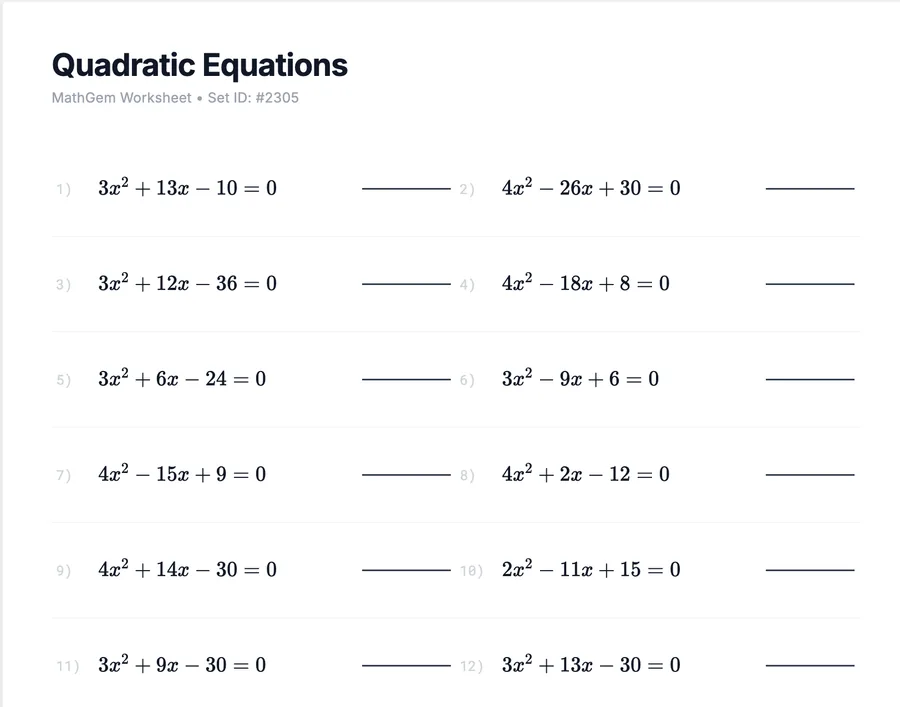
Quadratic Equations · Systems of Equations · Polynomial Multiplication · Factoring Polynomials · Radical Expressions · Exponential Equations · Matrices
 Pre-Calculus
Grades 11–12
Functions, logarithms, trigonometry, sequences and series, and circles.
Functions · Logarithms · Trigonometry · Sequences & Series · Conic Sections
 Geometry
Grades 3–9
Area, angles, circles, Pythagoras, volume, transformations, similar shapes, views and nets, all drawn to scale.
Area & Perimeter · Angles · Triangles & Parallelograms · Circles · Pythagorean Theorem · Volume · Surface Area · Transformations · Similar Figures & Scale · 3D Views & Nets · Nets of Solids
 Data & Probability
Grades 5–8
Mean, median, mode and range, and probability with dice, coins, spinners and tree diagrams.
Mean, Median & Mode · Probability
How it works
- Pick a topic. Choose a level, then a topic such as quadratic equations or long division.
- Choose the settings. Set the difficulty or the size of the numbers, and how many pages you need, up to 10 at a time.
- Generate and print. Every press of Generate makes a new set of problems. The answer sheet prints on its own page, with a Set ID that matches the worksheet.
- Teach the idea. Each topic page explains the method, works through examples at every difficulty and lists the most common mistakes.

For parents
Start with a page or two a day and build up from there. After the four operations, each topic page helps you explain the next idea at home, with worked examples and the mistakes to watch for.
“My two children built their math foundations on an early version of MathGem, solving about 100 problems a day, starting with the four operations.” Thomas Lee, MathGem's creator

For teachers
Print a different set for every class or every student, at the right difficulty, with an answer key ready for marking. From Basic Math 2 to Pre-Calculus, every topic also has printable one-page lessons: a key concept, an investigation, worked examples and a short exercise.
Why MathGem
- Free, with no account. Nothing to sign up for and nothing to pay; generate as many worksheets as you need.
- Answers you can check. Answer keys are computed by the same code that makes the problems, and every topic's worked examples and generators are tested automatically before each update.
- More than a worksheet. Every topic page explains the method, shows worked examples and lists common mistakes.
- Running since 2017. MathGem is made by Thomas Lee in British Columbia, Canada. About MathGem →