What these worksheets practise
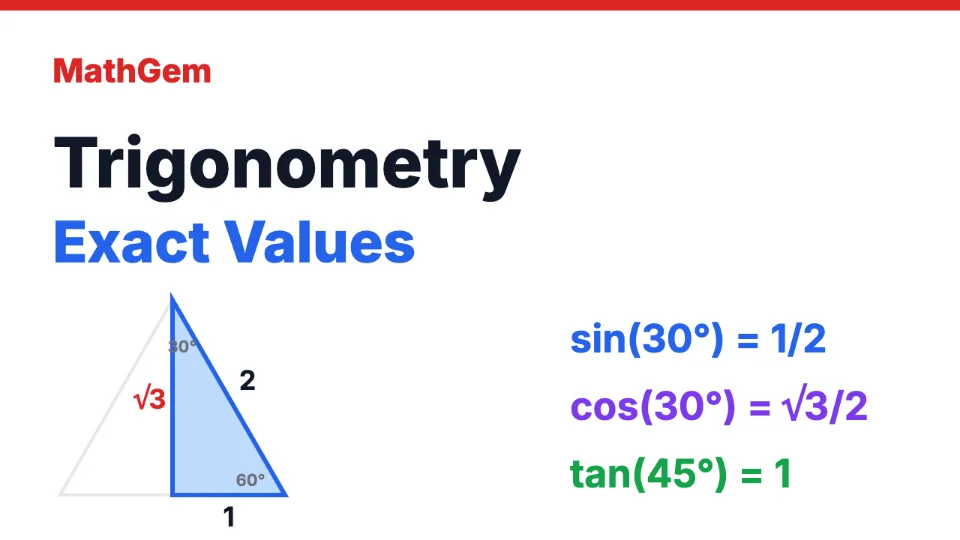
A handful of angles (0°, 30°, 45°, 60°, 90° and their matches in the other quadrants) have sine, cosine and tangent values that can be written exactly, using fractions and square roots. They come from two special right triangles: the 45°-45°-90° triangle with sides , and the 30°-60°-90° triangle with sides .
Beyond 90°, every angle has a reference angle (its acute angle to the -axis). The value has the same size as at the reference angle, and the quadrant decides the sign.
- Easy — exact values at 0°, 30°, 45°, 60° and 90° (first quadrant).
- Medium — exact values at special angles anywhere from 0° to 330°.
- Hard — solve or for both solutions in .
The steps below start with a single right triangle and add one idea at a time. By the end of step 3 a student can answer every Easy problem; step 4 adds the Medium angles and step 5 the Hard equations.
Watch: where the exact values come from (3:47)
Read the transcript
Let's learn where the exact values of sine, cosine and tangent come from, and how to use them at any angle.
In a right triangle, pick an acute angle. Sine is opposite over hypotenuse, cosine is adjacent over hypotenuse, and tangent is opposite over adjacent: SOH CAH TOA. In a 3-4-5 triangle, for the angle A opposite the 3: sin(A) = 3/5, cos(A) = 4/5 and tan(A) = 3/4.
Cut a square with side 1 along its diagonal. Each half has two 45° angles, legs 1 and 1, and hypotenuse √2. So sin(45°) = cos(45°) = 1/√2 = √2/2, and tan(45°) = 1/1 = 1.
Cut an equilateral triangle with side 2 in half. Each half has angles 30°, 60° and 90°, with sides 1, √3 and 2. From the 30° angle: sin(30°) = 1/2, cos(30°) = √3/2 and tan(30°) = 1/√3 = √3/3. From the 60° angle, the opposite and adjacent sides swap: sin(60°) = √3/2, cos(60°) = 1/2 and tan(60°) = √3.
Beyond 90°, put the angle in a circle of radius 1. The point on the circle is (cos, sin): at 0° it's (1, 0), and at 90° it's (0, 1). At 150°, the reference angle to the x-axis is 30°. In quadrant II sine is positive, so sin(150°) = sin(30°) = 1/2. Sine is positive in quadrants I and II, cosine in I and IV, and tangent in I and III. At 240°, the reference angle is 60°, and in quadrant III sine is negative: sin(240°) = −sin(60°) = −√3/2.
Going backwards, sin(x) = √2/2 has a reference angle of 45°. Sine is positive in quadrants I and II, so x = 45° and x = 180° − 45° = 135°. For cos(x) = −1/2, the reference angle is 60°, and cosine is negative in quadrants II and III: x = 180° − 60° = 120° and x = 180° + 60° = 240°.
Check with a calculator in degree mode: cos(120°) = −0.5, cos(240°) = −0.5, and sin(240°) is about −0.866, which matches −√3/2.
Watch out for these common mistakes. The wrong sign for the quadrant: sin(240°) is negative. Giving only one solution: cos(x) = −1/2 has two, 120° and 240°. Mixing up sine and cosine at 30°: sin(30°) = 1/2, but cos(30°) = √3/2. Drawing the triangle settles it. A calculator in radian mode: cos(120) in radians is about 0.814. It's the wrong mode, not a wrong answer.
Practise with free trigonometry worksheets and answer keys at mathgem.ca.
Worked examples, one step at a time
Step 1: sine, cosine and tangent in a right triangle
In a right triangle, pick one of the acute angles. The three ratios compare its sides: sine is opposite over hypotenuse, cosine is adjacent over hypotenuse, and tangent is opposite over adjacent ("SOH CAH TOA"). In a 3-4-5 triangle, for the angle opposite the side 3:
Step 2: the 45°-45°-90° triangle
Cut a square with side 1 along its diagonal. Each half is a right triangle with two 45° angles, legs 1 and 1, and hypotenuse . Reading the ratios off this triangle:
Step 3: the 30°-60°-90° triangle
Cut an equilateral triangle with side 2 in half. Each half has angles 30°, 60° and 90°, with sides 1 (opposite 30°), (opposite 60°) and 2 (the hypotenuse). The same triangle gives both angles:
Steps 2 and 3, together with 0° and 90° from step 4, cover every Easy problem. For example, .
Step 4: angles beyond 90°
Place the angle at the center of a circle of radius 1, measured from the positive -axis. The point where it meets the circle has coordinates . At 0° the point is , so and ; at 90° it is , so and .
For a larger angle, find its reference angle, the acute angle it makes with the -axis. The value has the same size as at the reference angle, and the quadrant gives the sign: sine is positive in quadrants I and II, cosine in I and IV, tangent in I and III.
These are the Medium problems: any special angle from 0° to 330°.
Step 5: going backwards, from a value to the angles
Hard worksheets give the value and ask for every angle from 0° up to (but not including) 360°. There are always two. First find the reference angle from the size of the value, then use the signs from step 4.
For : the reference angle is 45°, and sine is positive in quadrants I and II, so and .
For : the reference angle is 60°, and cosine is negative in quadrants II and III:
Check your answers
A calculator in degree mode gives and , and , which matches .
Common mistakes
- Wrong sign for the quadrant. Sine is positive in quadrants I and II, cosine in I and IV, tangent in I and III. is negative.
- Giving only one solution. Between 0° and 360°, has two solutions. Stopping at 120° misses 240°.
- Mixing up sine and cosine at 30° and 60°. but . Drawing the triangle settles it.
- Calculator in radian mode. Checking in radians gives about 0.814, which looks like a wrong answer but is only the wrong mode.
Sample problems
These problems come from the same generator as the worksheet above, three at each difficulty level. Press Generate for a fresh set.
Easy
Medium
Hard
Find x ∈ [0°, 360°)
Find x ∈ [0°, 360°)
Find x ∈ [0°, 360°)
Show answers
Tips for teachers and parents
- Have students sketch the two special triangles at the top of every Easy worksheet until they can recall the values without them.
- For Medium and Hard, a quick sketch of the angle on a set of axes makes the reference angle and the sign visible.
- and are undefined, so they never appear as problems; they make a good discussion question.