Circles in the coordinate plane
Conic sections are the curves made by slicing a cone: circles, parabolas, ellipses and hyperbolas. These worksheets currently cover the circle, the conic students usually study first.
A circle with center and radius is the set of points at distance from the center. Written with the distance formula, that gives the standard form:
- Easy — read the center and radius from an equation in standard form.
- Medium — rewrite in standard form by completing the square.
- Hard — write the equation from the center and one point on the circle.
The steps below start from a circle around the origin and add one idea at a time. Steps 1–3 are enough for the Easy worksheets, step 4 (completing the square) is for Medium, and step 5 is for Hard.
Watch: the equation of a circle, step by step (3:45)
Read the transcript
Let's learn the equation of a circle: how to read it, how to rebuild it, and how to write it.
A circle is every point at the same distance r from its center. With the center at the origin, a point (x, y) is √(x² + y²) away, so the circle of radius 5 is x² + y² = 25. Try a few points: (5, 0) gives 25 + 0 = 25, (0, −5) gives 0 + 25 = 25, and (3, 4) gives 9 + 16 = 25.
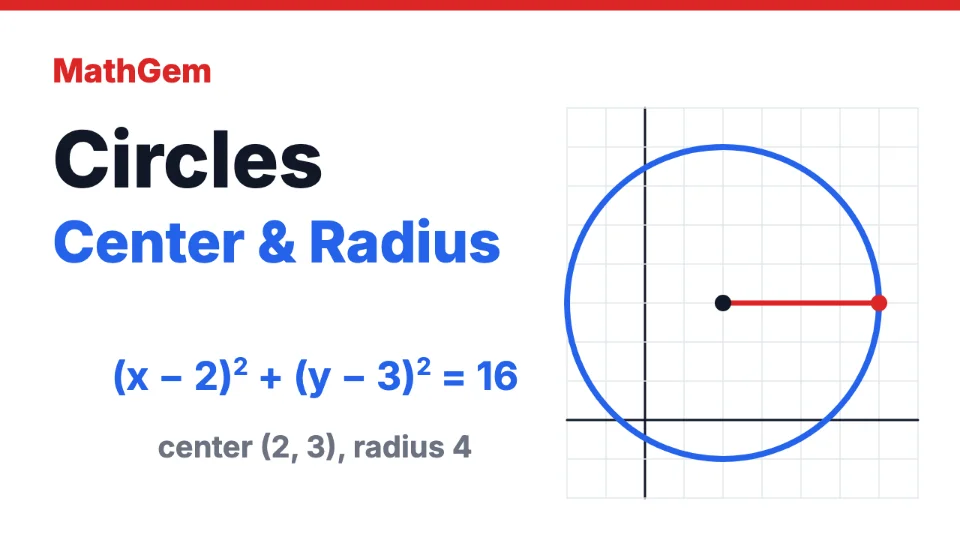
To move the center to (h, k), measure from there instead: subtract h from x and k from y. That's the standard form, (x − h)² + (y − k)² = r². A circle with center (2, 3) and radius 4 is (x − 2)² + (y − 3)² = 16. Every point on it, such as (6, 3), is 4 units from the center.
To read an equation, go backwards. In (x − 2)² + (y + 5)² = 49, the numbers inside appear with the opposite sign, because y + 5 is y − (−5). So the center is (2, −5). The right side is r², so the radius is √49 = 7. If a variable stands alone, as in x² + (y − 1)² = 9, that coordinate is 0: center (0, 1), radius 3.
Medium worksheets give the circle multiplied out, like x² + y² − 6x + 4y = 12. Rebuild each square. For x² − 6x: take half of −6, which is −3, and square it: (−3)² = 9. Then x² − 6x + 9 = (x − 3)². For y² + 4y: half of 4 is 2, and 2² = 4, so y² + 4y + 4 = (y + 2)². Whatever you add on the left, add on the right too: 12 + 9 + 4 = 25. So (x − 3)² + (y + 2)² = 25: center (3, −2), radius 5.
Hard worksheets give the center and one point on the circle: center (−1, 4) and the point (−1, 7). The radius is the distance between them. Both have x = −1, so it's straight up: 7 − 4 = 3. Put the center and r² = 9 into standard form: (x + 1)² + (y − 4)² = 9. Check by substituting the point: (−1 + 1)² + (7 − 4)² = 0 + 9 = 9. It lies on the circle.
Watch out for these common mistakes. Taking the sign from the equation: (y + 5)² means k = −5, not 5. Confusing r and r²: for = 49 the radius is 7, not 49. Completing the square on one side only: the 9 and the 4 added on the left go on the right too, making 25, not 12. Writing r instead of r²: the equation ends in = 9, not = 3.
Practise with free circle worksheets and answer keys at mathgem.ca.
Worked examples, one step at a time
Step 1: a circle around the origin
A circle is every point at the same distance from its center. If the center is the origin, a point is at distance by the Pythagorean theorem, so the circle of radius 5 is
Try a few points: gives , gives , and gives . All three are on the circle.
Step 2: moving the center
To move the center to , measure from there instead: subtract from and from . This is the standard form. A circle with center and radius 4 is
Step 3: reading the center and radius (Easy)
Read the standard form backwards. The numbers inside the brackets appear with the opposite sign, because is . The right side is , so take its square root.
For : center , radius . If a variable appears on its own, as in , that coordinate of the center is 0: center , radius 3.
Step 4: completing the square (Medium)
Medium worksheets give the circle multiplied out, such as . To get back to standard form, rebuild each square. Start with the -terms alone: is missing a number to be a perfect square. Take half of , which is , and square it to get 9:
Do the same for : half of 4 is 2, and . Whatever you add on the left must also be added on the right:
Now read it as in step 3: center , radius 5.
Step 5: building the equation from two points (Hard)
Hard worksheets give the center and one point on the circle. The radius is the distance between them. For center and the point , both have , so the distance is simply . Put the center and into standard form:
Check your answers
Substitute the given point: . The point lies on the circle.
Common mistakes
- Taking the sign from the equation. means , and means . The center's coordinates have the opposite signs.
- Confusing and . The right side is . For the radius is 7, not 49.
- Completing the square on one side only. The 9 and 4 added on the left must also be added on the right.
- Writing instead of . In the step 5 example the equation ends in , not .
Sample problems
These problems come from the same generator as the worksheet above, three at each difficulty level. Press Generate for a fresh set.
Easy
Find center and radius
Find center and radius
Find center and radius
Medium
Write in standard form; state center and radius
Write in standard form; state center and radius
Write in standard form; state center and radius
Hard
- Circle: center passes through
Write the equation - Circle: center passes through
Write the equation - Circle: center passes through
Write the equation
Show answers
- Center:
- Center:
- Center:
- Center:
- Center:
- Center:
Tips for teachers and parents
- Plot one circle from each worksheet on grid paper; seeing the center and radius makes the sign rule easy to remember.
- Medium problems build on perfect-square trinomials from Factoring Polynomials. A quick review of helps.
- The unit circle links this topic to trigonometry.