What are like terms?
Terms are like terms when they have exactly the same variable part: and are like terms, and so are 9 and , but and are not. Simplifying an expression means combining like terms by adding their coefficients, so that each kind of term appears only once.
The sign in front of a term belongs to that term. In , the terms are , , and ; the has coefficient .
- Easy — three or four -terms.
- Medium — -terms and constants mixed together.
- Hard — -terms, -terms and sometimes a constant.
Watch: combining like terms (2:53)
Read the transcript
Let's learn how to simplify an expression by combining like terms.
Terms are like terms when they have exactly the same variable part. 5x and −2x are like terms, and so are 9 and −3. But 5x and 5y are not: one is about x, the other about y. The sign in front of a term belongs to that term. In 4x + 9 − x − 3, the terms are 4x, 9, −x and −3. And −x has coefficient −1: a lone x means 1x.
Easy: 5x − 2x + 7x. All three are x-terms, so combine their coefficients: 5 − 2 + 7 = 10. So 5x − 2x + 7x = 10x.
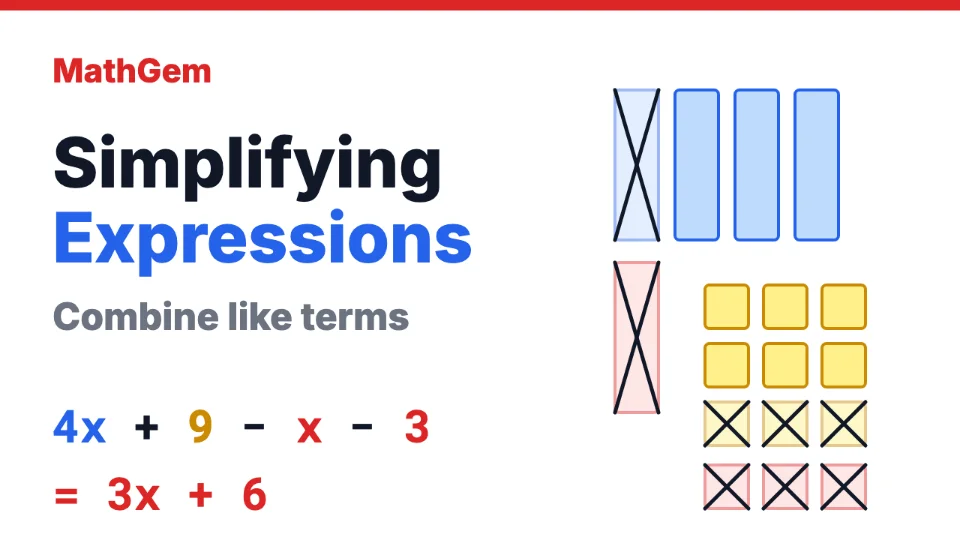
Medium: 4x + 9 − x − 3. Picture it with algebra tiles: 4 blue x-tiles and 9 yellow units, and red tiles for the subtracted x and 3. A positive and a negative tile cancel. 4x − x = 3x, and 9 − 3 = 6. So 4x + 9 − x − 3 = 3x + 6. An x-tile never cancels a unit tile, so like terms are combined separately.
Hard: 3x − 2y + 5 + x + 6y. Combine x with x and y with y. The 5 has no partner. Group them: 3x + x − 2y + 6y + 5. Then 3 + 1 = 4 and −2 + 6 = 4. The answer is 4x + 4y + 5. Check with x = 2 and y = 1. The original gives 6 − 2 + 5 + 2 + 6 = 17, and the answer gives 8 + 4 + 5 = 17. They match.
Watch out for these common mistakes. Combining unlike terms: 4x + 4y is already simplified. It is not 8xy or 8x. Leaving the sign behind: in 4x + 9 − x − 3 the term is −x, so the x-terms give 3x, not 5x. Forgetting the invisible 1: x means 1x, so −7x − x = −8x, because −7 − 1 = −8. Adding a constant to an x-term: 3x + 6 cannot become 9x.
Practise with free simplifying expressions worksheets and answer keys at mathgem.ca.
Worked examples
Easy:
All three are -terms: .
Medium:
Group the -terms and the constants: and .
Hard:
Combine with and with ; the 5 has no partner.
Check your answers
Substitute small numbers into the original and the answer. With and in the hard example: and .
Common mistakes
- Combining unlike terms. is already simplified; it is not or .
- Leaving the sign behind. In , the term is , so the -terms give , not .
- Forgetting the invisible 1. means , so .
- Adding a constant to an -term. cannot become .
Sample problems
These problems come from the same generator as the worksheet above, three at each difficulty level. Press Generate for a fresh set.
Easy
Medium
Hard
Show answers
- -3x
- -13x
- 3x
- 4x + 3
- 8x + 11
- -4x - 7
- 17x + 14y
- 13x + 4y + 3
- 4x + 6y
Tips for teachers and parents
- Colour or underline each kind of term (for example -terms in one colour, constants in another) on the first few worksheets.
- Rewriting subtraction as adding a negative ( as ) helps students who lose signs.
- This skill is used in every later topic: the distributive property and solving equations both end by combining like terms.