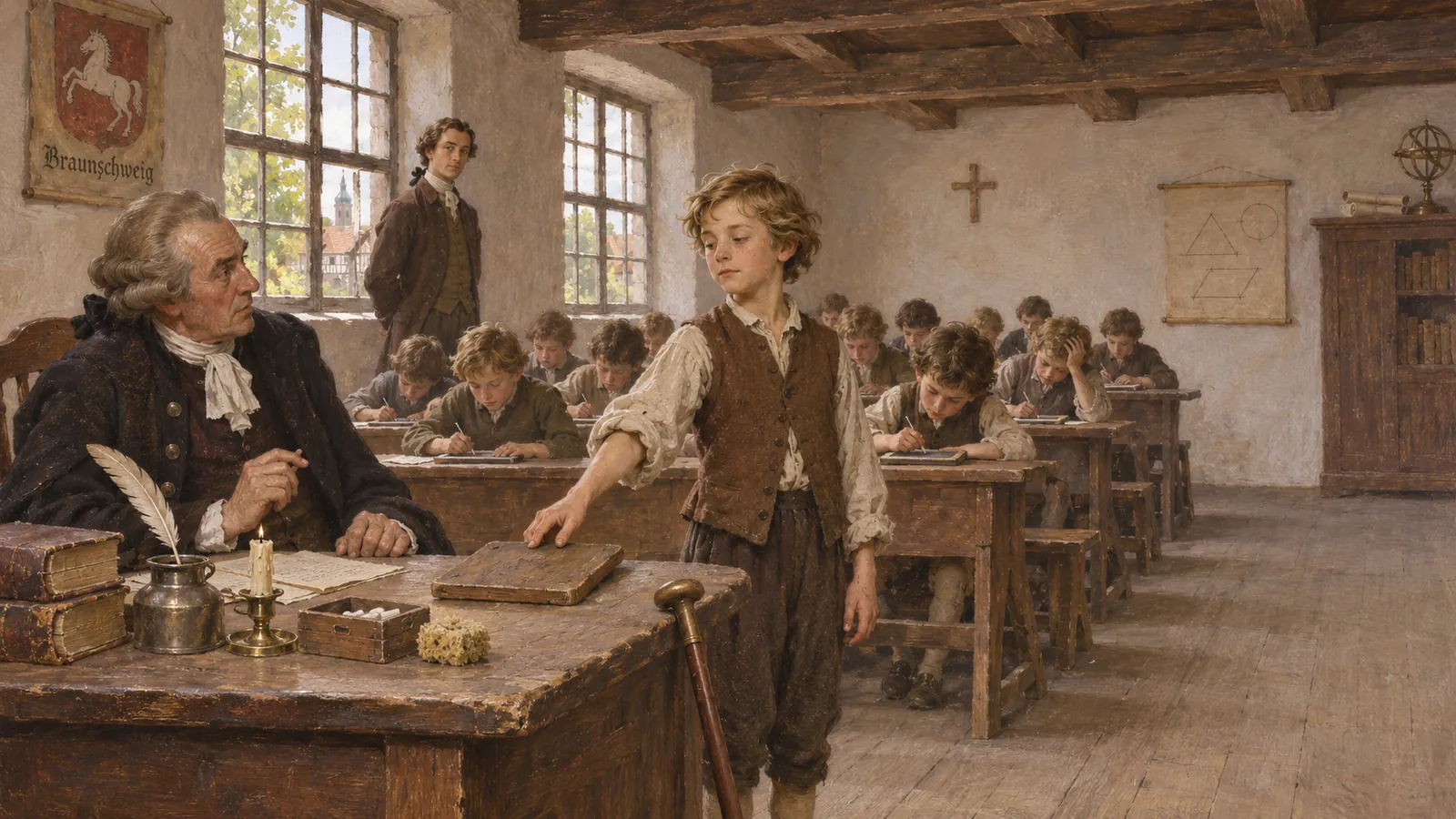
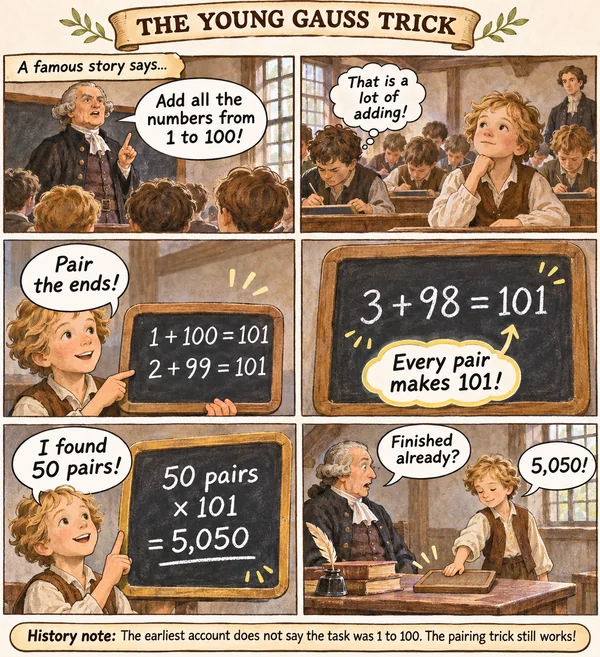
Ask a mathematics teacher to tell a story about a clever child and there is a good chance you will hear this one. A schoolteacher, wanting some quiet, tells his class to add up all the whole numbers from 1 to 100. Within moments a small boy named Carl Friedrich Gauss puts down his slate with the answer, 5050, while the rest of the class is still scribbling. The boy had noticed that the numbers could be paired from the two ends: , , , and so on, every pair making 101. There are 50 such pairs, so the total is .
The mathematics is perfectly sound. The story around it is another matter, and the way it changed over the years is worth telling too.
The setting is real enough. Gauss was born in Brunswick, in what is now Germany, on 30 April 1777. According to the MacTutor History of Mathematics, he started elementary school at the age of seven, and his teacher was a man named Büttner. Büttner had a young assistant, Martin Bartels, who loved mathematics and who went on to become a mathematician himself. Gauss grew up to be one of the most important mathematicians in history, so it is natural that people wanted to know what he was like as a child.
The earliest published account of the arithmetic lesson that historians point to comes from after his death. Gauss died in 1855, and in 1856 his friend Wolfgang Sartorius von Waltershausen published a short memoir called Gauss zum Gedächtniss, "In Memory of Gauss". Sartorius was one of Gauss's close friends and is considered his first biographer, and the schoolroom scene appears in his book as a story from Gauss's childhood. That is a long way from the classroom. It was written down decades after the event, and it reaches us by way of an old man's memories of his boyhood, as told to a friend.
Here is the part that surprises most people. According to the historians who have studied the sources, including the mathematics writer Brian Hayes, who wrote about the story in American Scientist in 2006, Sartorius did not say that the class was asked to add the numbers from 1 to 100. He described only an arithmetic series, a list of numbers in which each one is a fixed amount larger than the one before. The exact task is not recorded. Later tellings, and the English translation of Sartorius, supplied a neat and memorable version, 1 to 100, and some retellings use other numbers, such as 1 to 60. The story became simpler and tidier every time it was told, which is what stories tend to do.
So what can we say with confidence? That the story was told about Gauss within a year of his death is documented. What we cannot say is that the lesson happened exactly as it is told in textbooks and on classroom posters. A careful teacher might simply tell the children: this is the popular version, and the earliest account is vaguer.
The wonderful thing is that the trick does not depend on the story. It works for any list of numbers that go up by the same step. Take the numbers from 1 to 60, a version that appears in some retellings. There are 30 pairs, each adding up to 61, so the total is . The general rule, for the whole numbers from 1 up to , is
You can see why with a very small case. For 1 to 10 there are five pairs, each making 11, so the sum is . The method even works when the list does not start at 1. Here is a problem to try before reading on: what is ? The first and last numbers add to 105, the second and second-last add to 105 again, and there are 20 numbers in the list, which makes 10 pairs. The answer is . It is a good moment to ask a child why the pairs always match up, and what happens when the list has an odd number of terms, so that one number is left over in the middle.
Whether or not a boy in Brunswick really did this at his desk, the idea he is credited with is a real and useful one: look at the structure of a problem before starting to calculate. A child who has met the story once is likely to remember it, and the trick comes back later in school, when sums of long lists turn into the formulas for arithmetic series. You can practise the plain, one-number-at-a-time version on our addition worksheets, and meet the pairing idea again, written with symbols, in the sequences and series worksheets.
Sources: J. J. O'Connor and E. F. Robertson, "Carl Friedrich Gauss" and "Johann Martin Christian Bartels", MacTutor History of Mathematics, University of St Andrews; Wolfgang Sartorius von Waltershausen, Gauss zum Gedächtniss (Leipzig, 1856); Brian Hayes, "Gauss's Day of Reckoning", American Scientist 94(3), 2006.