
Imagine you have to multiply two numbers that each have eight digits, and then do it again a few hundred times, with nothing but pen and paper. For astronomers and navigators around the year 1600 this was ordinary work, and one slipped digit could spoil an afternoon of calculation. A way to make the work shorter was published in 1614 by a man who was not a professional mathematician at all.
John Napier was born around 1550 and lived at Merchiston, near Edinburgh, where he managed the lands of his family. Mathematics was something he did alongside that. By his own reckoning, the work took him about twenty years before it appeared in print, in a Latin book called Mirifici Logarithmorum Canonis Descriptio, which means something like "Description of the Wonderful Rule of Logarithms". Much of the book is tables of numbers.
The idea behind the tables is one that a child can see with powers of two. Write and . To multiply 32 by 128 you do not need to multiply at all. You only add the small numbers on top, , and then read off . Multiplying the big numbers became adding the little ones. Napier's problem was that most numbers are not neat powers of two, so he needed a way to give every number its own small partner number. He called these partners logarithms, from Greek words that can be understood as "ratio numbers". Building the table by hand, entry after entry, is what took him about twenty years.
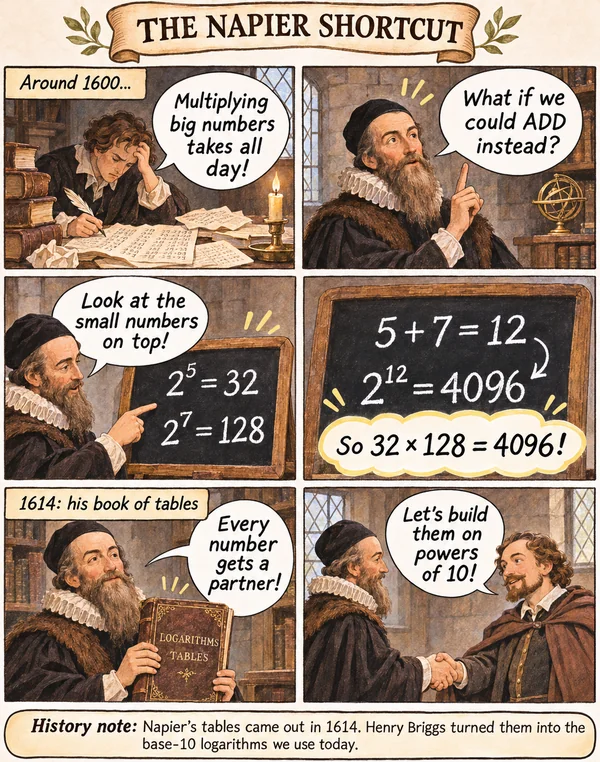
With such a table, the work goes like this. To multiply 3.7 by 2.4, look up the partner of each number. In the base-10 logarithms we use today they are about 0.5682 and 0.3802. Add them to get 0.9484, then use the table backwards to find which number has that partner. The answer is about 8.88, and a calculator agrees that . Division works the same way, with subtraction in place of addition.
Napier's own logarithms were not quite the ones we use now, and the change that made them convenient came from a visitor. Henry Briggs was the first professor of geometry at Gresham College in London. He had already suggested in a letter that the tables should be built on powers of ten, and in the summer of 1615 he made the long journey to Edinburgh to meet Napier. The two agreed on the new tables, with the logarithm of 1 set to 0. In that system, multiplying a number by 10 simply adds exactly 1 to its logarithm. For example, the partner of 2 is about 0.30103, so the partner of 20 is 1.30103 and the partner of 200 is 2.30103. Only the part after the decimal point ever needs to be looked up. A neat example is : the partners add to exactly 3, and .
Napier died in 1617, only a few years after his book appeared. Briggs carried the work on. In 1617 he published the base-10 logarithms of the numbers from 1 to 1000, calculated to fourteen decimal places, and in 1624 his Arithmetica Logarithmica extended them to roughly thirty thousand numbers. These are the "common" logarithms, and tables of them stayed in use for generations.
The French mathematician Pierre-Simon Laplace is often quoted as saying that logarithms, by shortening the labour, doubled the life of the astronomer. It is a lovely sentence, and it is repeated widely. We found it credited to Laplace in collections of quotations, but not in a source we could trace back to his own writing, so treat it as "attributed to Laplace" rather than as something he certainly wrote. The sentiment, at least, is easy to believe. Anyone who has multiplied by hand for an hour knows what a table of logarithms would have been worth.
Today a calculator multiplies instantly, and logarithms might seem like a museum piece. They are not. The same idea, that a partner number turns multiplying into adding, is how we measure earthquakes, sound and acidity, and it is the key to solving equations where the unknown sits in an exponent. If you would like to see how the partner numbers behave, our logarithm worksheets start with exactly the rules in this story, and they practise the step that Napier and Briggs spent years making possible: turning a product into a sum.
Sources: John Napier, Mirifici Logarithmorum Canonis Descriptio (Edinburgh, 1614); J. J. O'Connor and E. F. Robertson, "John Napier" and "Henry Briggs", MacTutor History of Mathematics, University of St Andrews; Henry Briggs, Arithmetica Logarithmica (London, 1624); Howard Eves, In Mathematical Circles (1969), where the Laplace remark is quoted.