Every child who learns to add meets the equals sign in the first week. It sits in the middle of as if it had always been there. It is younger than you might think. Before 1557 there was no such sign anywhere in print, and mathematicians who wanted to say that two things were equal had to write it out in words, in Latin or in their own language, every single time.
The person who changed that was Robert Recorde, a doctor and mathematician born in Tenby, Wales, around 1510. He studied at Oxford and earned a degree in medicine at Cambridge, but he is remembered for something unusual for a scholar of his time: he wrote mathematics books in English, for ordinary readers, instead of in Latin for other scholars. His arithmetic book, The Grounde of Artes, first appeared in 1543 and was reprinted many times. He wrote it as a conversation between a master and a student, so that someone learning alone could follow along.
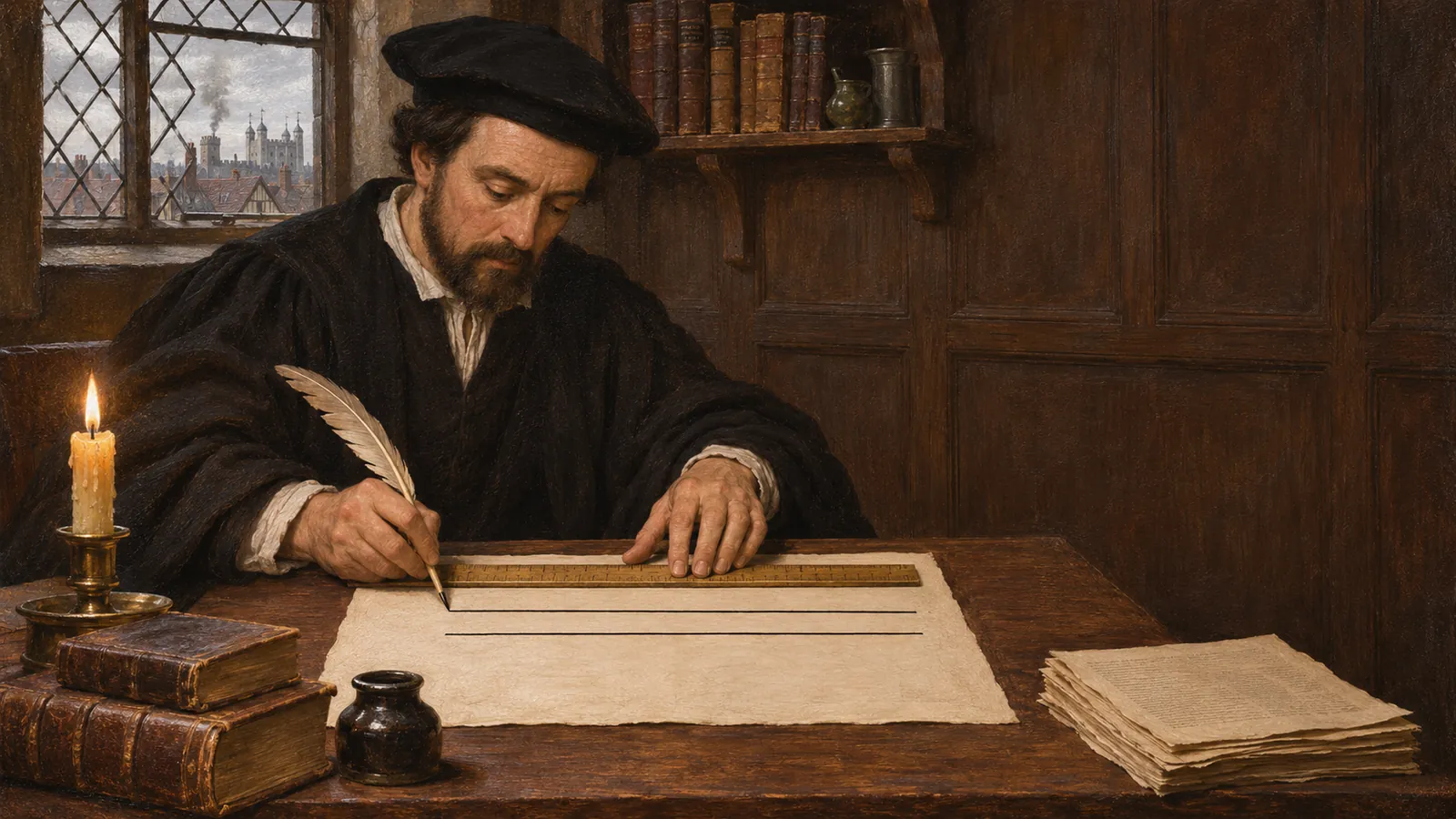
Recorde's last book, The Whetstone of Witte, was published in London in 1557. A whetstone is a stone for sharpening knives, and the title promised to sharpen the reader's wits. It was a book about algebra, which meant that it was full of equations, and every equation needed the words "is equal to". Recorde decided he had written those words often enough. In the spelling of his day, he explained:
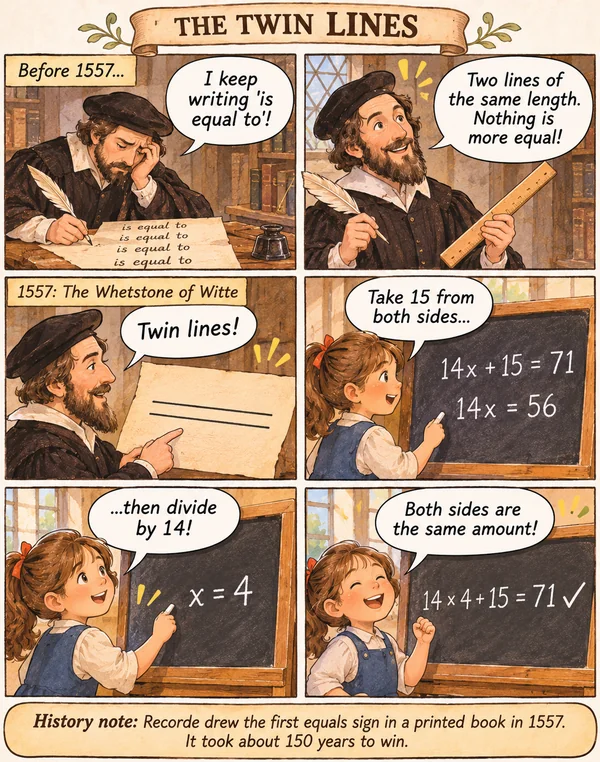
"And to avoide the tediouse repetition of these woordes : is equalle to : I will sette as I doe often in woorke use, a paire of parralles, or Gemowe lines of one lengthe, thus : =, bicause noe .2. thynges, can be moare equalle."
"Gemowe" is an old word for twins. Two parallel lines of the same length, side by side and never meeting, were his picture of two things that are exactly the same. It is a lovely reason for a symbol, and it is the reason we still use. In the printed book the lines are much longer than ours, stretched out almost like a short dash drawn twice, but the idea is exactly the one on every worksheet today.
Recorde also wrote down what is often called the first equation with an equals sign. In his notation it used special marks for the unknown number and for ordinary units, but in today's symbols it says . It is worth pausing here to solve it. Take 15 away from both sides and you have ; divide by 14 and . You can check it the way students are taught to check any equation: is , which is 71, so both sides really are equal.
Recorde did not live to see his sign catch on. He had been working for the crown, running a mint and then supervising silver mines in Ireland, and his work there led to disputes with powerful people. In 1556 the Earl of Pembroke sued him for libel. Recorde lost and was ordered to pay a sum he could not afford, and he died in the King's Bench prison in London in 1558, a year after his algebra book came out.
For a long time afterwards, his invention looked like it might disappear with him. The sign does not show up again in print until 1618, and it only became familiar in England in 1631, when three influential books used it: Thomas Harriot's book on algebra, William Oughtred's popular textbook Clavis Mathematicae, and Richard Norwood's book on trigonometry. Even then it had rivals. Some writers used two vertical lines, , for "equals". In France, René Descartes used a completely different mark in his famous La Géométrie of 1637, a sign that looked a little like a sideways letter, and for some years his version was more popular than Recorde's on the European mainland. There is even a manuscript in Bologna, from around the same years, that uses two parallel lines for equality, so Recorde may not have been the only person to have the idea, only the first to put it in a printed book.
What finally settled the matter was not an argument but a choice made by the most famous mathematicians of the next century. Isaac Newton in England and Gottfried Wilhelm Leibniz in Germany both wrote equations with Recorde's two lines, and when the people everyone else was reading used the same sign, the rest followed. By the early 1700s the equals sign had won, about 150 years after a doctor in London decided he was tired of writing the same four words.
It is worth telling children this story when they first meet , because it explains something they often get wrong. Many young students read the equals sign as "and the answer is", which is why a problem like can seem strange to them: the answer is not on the right. Recorde's twin lines mean something better than "the answer comes next". They mean that the two sides are the same amount, which is exactly the idea that lets a student solve by doing the same thing to both sides. The same two lines run down every page of our addition worksheets, and they are what holds every problem together on the solving equations worksheets, where keeping both sides equal is the whole game.
Sources: Robert Recorde, The Whetstone of Witte (London, 1557); J. J. O'Connor and E. F. Robertson, "Robert Recorde", MacTutor History of Mathematics, University of St Andrews; Jeff Miller, "Earliest Uses of Symbols of Relation", hosted by MacTutor; Florian Cajori, A History of Mathematical Notations (1928).